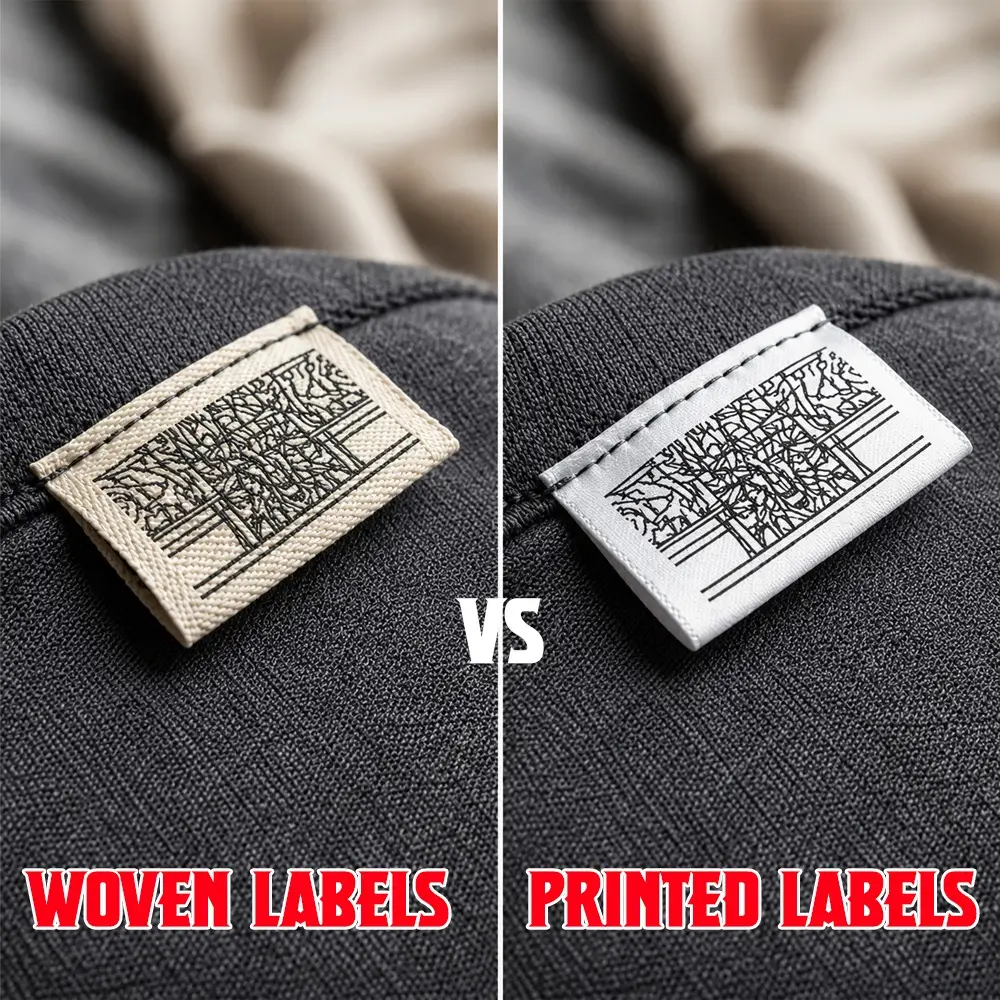
I remember a few years back, I noticed when I bought two shirts from the same shop. Both labels had different feelings. One was soft and smooth, while the other one was like threads woven into it. I was very curious about the difference. Because I caught that about my brand too.
That is why I have brought this guide about woven labels vs printed labels. Most guides you find will tell you about the best or better label. But not what is right about a specific label. At the end of this guide, you will learn which label makes sense for your brand. Let’s begin.
Woven Labels vs Printed Labels: Understand The Difference
Woven Labels
Think of a woven label like a tiny piece of fabric with your design stitched right into it. Threads are woven together on a loom, like making cloth. Your logo becomes part of the fabric itself. When you touch it, you can feel the design a little raised under your fingers. On your
custom hoodies or
sports t-shirts, it feels premium and permanent.
Printed Labels
A printed label is like a small piece of paper or fabric with your design printed on top using ink. The design sits flat on the surface. It does not have that raised, stitched feeling. When you run your finger over it, everything feels smooth. It works great for detailed designs and small text.
Imagine Holding Both Side by Side
Close your eyes and picture this. In your left hand, you have a woven label. It feels thick and soft like a tiny cloth badge. You can feel each letter with your fingertip because the threads create a gentle bump. In your right hand, you have a printed label. It feels thin and silky smooth. The design looks sharp and clear, almost like a tiny photograph. One feels like fabric. The other feels like smooth paper or satin. That is the main difference you will notice right away.
The Comparison Matrix
Here is a quick look at how woven and printed labels compare side by side.
| Factor |
Woven Labels |
Printed Labels |
| Look & Feel | Raised texture, premium finish | Flat surface, smooth touch |
| Durability | Lasts 50+ washes | Lasts 20–30 washes |
| Detail Level | Simple designs work best | Fine details and gradients work well |
| Cost Per Label | Higher | Lower |
| Setup Fees | $50–$150 | $0–$30 |
| Minimum Order | Usually 500+ pieces | As low as 25 pieces |
| Skin Comfort | Can feel slightly scratchy | Soft and smooth |
| Production Time | 2–4 weeks | 3–7 days |
The Factors Nobody Talks About
Most articles stop at cost and durability. But there are hidden factors that can make or break your choice of label. Let us talk about the things nobody mentions.
Factor 1
Skin Feel Deep-Dive
Not all labels feel the same against the body. This matters more than you think.
Baby Clothes
Babies have soft, sensitive skin. A woven label with thick threads can feel scratchy and cause redness. Printed labels on smooth satin or cotton are gentle and flat. They will not irritate tiny bodies. For baby clothes, printed wins every time.
Activewear
Activewear apparel stretches, bends, and gets soaked in sweat. Woven labels hold up well to washing but can chafe against skin during movement. Many activewear brands now choose printed fabrics to avoid skin irritation.
Lingerie
Lingerie sits against the most sensitive parts of the body. A woven label with raised threads feels rough and ruins the comfort. Printed labels on silky smooth fabric disappear against the skin, maintaining the soft, delicate feel people expect.
Factor 2
Sustainability Comparison
People care about the planet. Your label choice has an environmental impact.
Woven Labels
Most woven labels use polyester threads. Polyester is plastic — it does not break down naturally and stays in landfills for decades. Some suppliers offer organic cotton threads, which are better but less durable.
Printed Labels
Printed labels can use water-based inks, which are safer for the environment. Some backings are made from recycled paper or FSC-certified material. But cheap printed labels may use chemical inks and plastic-heavy substrates.
End of Life
A woven polyester label will outlive the garment and sit in a landfill forever. A printed label on cotton or paper will break down naturally. If being eco-friendly is part of your brand story, choose materials that match that promise.
Factor 3
Label Compliance Made Simple
Certifications build trust. But not all label types make certification easy.
OEKO-TEX Certification
This certification means no harmful chemicals are present. Woven labels for
sports clothing made from certified polyester threads pass the test. Printed labels must use OEKO-TEX-approved inks. It is possible for both, but printed needs extra checking.
GOTS (Organic)
GOTS certification requires organic materials. Woven labels with organic cotton threads qualify. Printed labels need organic fabric backing and approved inks. This is harder to achieve with printed labels, but not impossible.
CPSIA (Children’s Products)
In the USA, children’s products must meet safety standards for lead and chemicals. Both label types can comply, but printed labels must prove their inks are safe. Ask your supplier for test reports before ordering labels for kids.
Factor 4
Future-Proofing Your Labels
What happens when you want to change your logo next year?
Woven Labels
You order a large quantity upfront. If your logo changes, those labels become waste. The setup fees and long production time make quick changes expensive. Woven works best for established brands with a fixed identity.
Printed Labels
You can order small batches. If you rebrand, you only waste a few labels. New designs print quickly and cheaply. Printed labels are perfect for new brands still finding their look.
Factor 5
Regional Care Label Laws
Different countries have different rules for what your care label must show.
USA (FTC Rules)
The USA requires care instructions in English. You must include washing, drying, bleaching, and ironing information on garments like
custom leggings. The text must be readable and stay legible for the life of the garment. Woven labels hold up well, but printed text can fade.
European Union
EU rules need care symbols, not words. The symbols must meet ISO standards. Both label types work, but woven symbols last longer through washes.
United Kingdom (Post-Brexit)
The UK now follows its own rules, like the EU, but with some differences. Care symbols are a must. Labels must also show fiber content. Printed labels are common here because brands can add required details without high setup costs.
Decision Framework by Business Type
Your business size and goals should guide your label choice. Here is a simple breakdown for each stage.
Stage 1
Startup or Indie Brand (Under 100 Pieces)
You are just starting. Money is tight, and you are testing ideas. Printed labels are your best friend here. There are no setup fees, so you save money right away. You can order as few as 25 pieces, which means no wasted stock. Turnaround is fast, so you get labels in days, not weeks. If you change your logo next month, you are not stuck with thousands of useless labels. Keep it simple and flexible.
Stage 2
Scaling Brand (500 to 2,000 Pieces)
Your brand is growing. Orders are getting bigger, and you want to look more professional. This is where a hybrid approach works best. Use woven labels for your main brand tag — it gives your clothing that premium, established feel customers notice. Then use printed labels for care tags and size tags. You save money on the hidden labels while upgrading the ones people see. Best of both worlds.
Stage 3
Established Brand (5,000+ Pieces)
You are ordering in bulk now. Woven labels become the smarter choice at this volume. The setup fee spreads thin across thousands of pieces, so the cost per label drops a lot. Think custom shapes, not only rectangles. Add metallic gold or silver threads for a luxury touch. Try folding labels or double-sided designs. Your brand is famous, so your logo is not changing anytime soon. Invest in labels that match your reputation.
Stage 4
Luxury or High-End Brand
Your customers expect the best. They notice tiny details and judge quality by touch. Woven labels with specialty threads like gold, silver, or even silk are the standard. The raised texture and subtle shine scream luxury. However, some high-end eco-brands now choose ultra-premium printed labels on organic cotton with water-based inks. It feels soft and minimal while staying elegant. Both paths work as long as the quality feels unmistakable.
Find Your Perfect Label Partner
The Right Partner Makes All the Difference
No matter where you are in your brand journey, the right partner makes all the difference. Get in touch with us and take the guesswork out of growing your brand.
Contact Us
The Hybrid Strategy
Most guides will tell you to pick one label type. But smart brands do not choose. They use both. Here is how and why.
Woven Main Brand Label + Printed Care & Size Labels
Your main brand label is the one everyone sees — it sits on the neckline or waistband and carries your logo. Make it woven. The raised threads catch the light and feel expensive. Then make care and size labels printed. You save money on the labels people rarely notice while spending where it counts. This combo gives you a premium look without wasting your budget.
Woven Neck Label + Printed Hang Tag Combo
Sew a small woven label on the neckline for that premium, permanent touch. Then attach a printed hang tag on the outside with extra information — your brand story, pricing, social media handles, or a QR code. Since people remove hang tags before wearing, they don’t need to be durable. The woven label stays on the garment forever, building brand recall every time someone wears it.
Why DTC Brands Are Going Hybrid
Direct-to-consumer brands sell online. Their customers do not touch the product before buying — but they do touch it the moment they open the package. A woven label says quality. Soft printed care labels show thoughtfulness and comfort. Together, they create an experience that feels intentional and premium. Customers notice these small details and share them in reviews and unboxing videos.
Common Mistakes to Avoid
Even experienced brands make these errors. Learn from them so you do not waste time and money.
Sending the Wrong Logo File for Woven Labels
Woven labels need a vector file in AI or EPS format. These files tell the loom exactly where each thread goes. If you send a raster file like JPG or PNG, the design turns into a blurry mess of pixels. Threads cannot map pixels. The result is a fuzzy, unreadable logo that looks cheap. Always check with your supplier about file types before you place an order.
Choosing Woven for Photo-Realistic Designs
Woven labels are made of threads, not magic. Threads cannot create smooth gradients, shadows, or tiny photographs. If your design has a face, a landscape, or fading colors, threads will make it look blocky and strange. Printed labels handle gradients and fine images with no problem. Use woven for bold logos and simple shapes. Use printed when your design needs to look like a photograph.
Ordering Huge Batches of Low-Quality Printed Labels
It is tempting to order 10,000 cheap printed labels to save money. But if the ink quality is poor, those labels will start fading after 15 washes. Cracking, peeling, and blurry text will follow. Your brand will look worn out before the garment does. It is smarter to order fewer labels from a quality supplier than a mountain of labels that fall apart. Check reviews and request samples first.
Ignoring Skin Sensitivity Complaints
Customers will tell you if a label bothers them — in reviews, returns, or simply by not buying again. A scratchy woven label on a T-shirt or baby onesie can ruin the wearing experience. Printed labels with rough edges can also cause itching. Pay attention to where your label sits and who will wear it. Choose softer materials for anything touching the neck, waist, or delicate skin. Small comfort details build loyal customers.
A Supplier Who Understands Technical Requirements
A good supplier is far more than creating goods for you. They must also understand the technical requirements that impact their daily work. This not only saves you from costly mistakes but also improves your product’s comfort.
Fortstitch stands out as a global supplier that understands your technical requirements. From choosing your fabric to labels, they know what works best and where. Choosing a partner like Fortstitch means you will get labels exactly as you imagined.
Get the Technical Details Right
Start Your Label Journey With a Partner You Can Trust
If you are looking for a label partner who gets the technical details right, reach out to Fortstitch today. Request a free quote and start your journey.
Ask for a Free Quote
Conclusion
Our conversation started with a simple question about woven labels vs printed labels. Now you have a detailed answer — not about which is better, but which one is suitable for your needs. You are a startup or an established brand. You need a luxury label or a soft label for baby clothes. You need in bulk or a small batch to test.
All these factors decide together the right choice for you. Think about your budget, your fabric, your customer, and your plans. Let those answers guide your decision, not a generic list of pros and cons.
FAQs
Q1. What is the difference between woven and printed labels?
Woven labels have your design stitched into fabric using threads, giving a raised, premium feel. Printed labels have your design applied on top of a surface using ink, resulting in a smooth, flat finish.
Q2. What are the three types of labels?
The three main types are woven labels made from interlaced threads, printed labels made with ink on fabric or paper, and hang tags made from cardstock attached to the outside of a garment.
Q3. How much does a woven label cost?
Woven labels typically cost between $0.15 and $0.60 per piece, depending on size, thread colors, and quantity. Setup fees range from $50 to $150 for creating the loom design.
Q4. What is the best material for labels?
The best material depends on your needs. Satin feels soft and looks shiny, cotton is natural and gentle on the skin, polyester is durable and affordable, and Tyvek is tear-resistant for outdoor use.
Q5. What are the different types of labels?
Different types include woven labels, printed labels, hang tags, care labels, size labels, heat transfer labels, leather patches, rubber labels, and metal badges used for branding.