
Pakistan vs China Activewear Manufacturer: Who is Better?

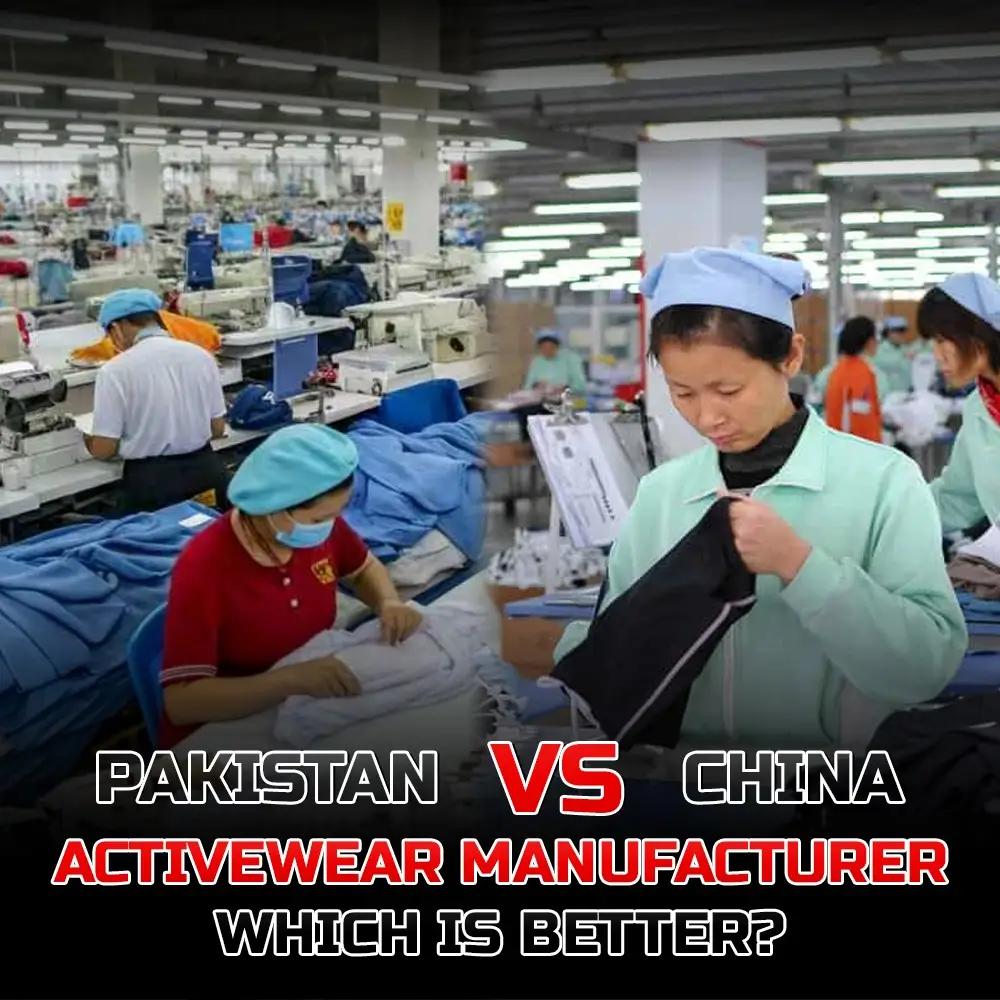
Suppose you are a brand or private label owner of a clothing brand. An activewear manufacturer for your clothing line is very important. China has captured the global market. But Pakistan is the name that always keeps coming up.
Confusion arises about when you need a reliable supplier for your business. And don’t know which one makes better sense. Who can provide you with better prices, customization, and better shipping? There is no universal rule for which country is “better”.
In this guide, we will tell you the real differences between the manufacturers. This will help you stop guessing and start ordering.
What Makes a Good Activewear Manufacturer in the First Place?
Before comparing countries, there are some other factors we need to consider.
Reliable activewear clothing manufacturers deliver four things :
- Quality that matches your samples – not only in the first order, but in every order.
- Transparent communication – no surprise pricing or delayed responses.
- Realistic MOQs – you shouldn’t need to order 3,000 units to test a design.
- On-time shipping – because your launch date isn’t flexible,
Both China and Pakistan can deliver these. But they do it in very different ways.
China: The Giant That Built the Global Apparel Industry
China didn’t become the largest manufacturer of activewear clothing by accident. They have built the scale, speed, and infrastructure that no one can beat.
Where China Is Outperforming Others?
Unmatched infrastructure. Ports, logistics, fabric suppliers, trim vendors—everything is within reach. This efficiency means faster production and predictable shipping.
Lower Prices for large buyers. If you are ordering in bulk quantities. Chinese suppliers will compete on price. They have automated systems for production. It lets them keep labor costs low.
Advanced fabric innovation. Need moisture-wicking with four-way stretch and antimicrobial treatment? Chinese manufacturers have likely produced it before. They invest in R&D for performance fabrics.
Where China Falls Short?
Quality inconsistency is real. The best Chinese factories are world-class. The mediocre ones will burn you. The problem is that factories look identical on Alibaba. You cannot expect perfection before working with anyone.
Rising costs. Wages in garment manufacturing hubs like Guangzhou and Fujian have climbed quickly. You cannot bargain like ten years ago.
Language and time zone friction for US brands. A 12-hour difference means your 9 AM email gets answered at 9 PM. That slows down sampling and problem-solving.
Pakistan: The Underestimated Alternative
Pakistan’s activewear manufacturing sector has grown in silence. Most US brands overlook it. That’s starting to change.
Where has Pakistan Done Well?
Vertical integration for cotton-based activewear. Pakistan is one of the world’s largest cotton producers. Many activewear manufacturers have full control over the whole process. From ginning the cotton to dyeing and from cutting to sewing. This means better quality at better rates.
Much lower MOQs. This is what a small brand wants. Where a Chinese factory asks for 1000 pcs. A Pakistani manufacturer for startups will ask for 200-300 pcs. Even some will go as low as 100 for a trial.
Strong English Communication. Pakistan was a British colony. They use the English language both in business and education. You get clear communication and faster replies than many Chinese suppliers.
Unlimited Customization. Pakistani manufacturers are used to smaller, hands-on buyers. They’re more willing to handle custom trims. Also, unique labels and specific packaging without massive surcharges.
Where Pakistan Falls Short?
Longer shipping times. From Karachi to New York, sea freight takes 30–40 days versus 15–20 days from Shanghai. That matters for restocks and tight launches.
Fewer synthetic fabric options. Pakistan excels at cotton blends. But has less experience with high-tech nylons, recycled polyesters, and specialty performance fabrics. If your line requires advanced technical textiles, China is safer.
Smaller factory scale. You won’t find many 5,000-worker facilities in Pakistan. That’s fine for orders under 10,000 pieces. Above that, China’s infrastructure scales better.
Head-to-Head Comparison: Activewear Manufacturers by the Numbers
| Factor | China | Pakistan |
| Minimum Order Quantity | 500–1,500 pcs per style | 200–500 pcs per style |
| Sample turnaround | 10–15 days | 12–18 days |
| Production lead time | 30–45 days | 35–50 days |
| Sea freight to the US (door-to-door) | 25–35 days | 45–55 days |
| Cost per unit (basic leggings) | $4.50–$6.50 | $3.50–$5.00 |
| Fabric sourcing options | Excellent for synthetics | Excellent for cotton blends |
| Communication clarity | Good with experienced agents | Very good direct |
Which One Is Right for Your Business Model?
The answer changes depending on who you are and what you want.
For Startups and Small Brands
Go with Pakistan.
If you are launching your brand new. You need custom activewear manufacturers for cotton t-shirts and hoodies. If you want to order small quantities, Pakistan is the smarter choice. The lower MOQs will save your budget and reduce upfront risk.
With a low cost per unit, you can earn better and healthier margins even at small scale. Also, you will get direct communication with the owner and manager. Not an operator or third-party buyers.
Most manufacturers for startups fail because the startup can’t meet the MOQ. Pakistan is your solution.
For Established Brands Scaling Past 10,000 Units
Consider China or a hybrid approach.
Once you need consistent volume at scale, China’s infrastructure becomes an advantage. You can lock in pricing, reduce per-unit costs further, and rely on faster restocks. The key is finding a verified factory—not the cheapest listing on a B2B platform.
A hybrid approach also works: use Pakistan for cotton-heavy basics. For hoodies, spandex leggings, and shorts. China for technical performance wear, like compression wear, and waterproof outer layers.
For Private Label and Wholesale Suppliers
It depends on your customers.
If your wholesale buyers want the lowest possible price. And can wait 60+ days for delivery, Pakistan wins. If they need faster turnover and technical fabrics, China is safer.
Many smart wholesale suppliers now source from both. They keep a Pakistan supplier for core cotton basics. Whereas a Chinese supplier is for seasonal performance pieces.
How to Find the Best Activewear Manufacturer for Your Needs?
Country matters less than the specific factory. Here’s how to vet any activewear manufacturer before sending money.
Request a sample before negotiating bulk pricing. Any random manufacturer will charge you for a sample. But should apply that cost to your first order. If they refuse to make samples or quote prices without seeing your tech pack, move on.
Ask for their defect rate. A good factory tracks this. Anything under 2% is solid. If they can’t tell you, they don’t measure it.
Start with a test order at half your target MOQ. Even if they claim 500 pieces minimum, ask if they’ll do 250 for the first run at a little higher per-unit cost. The best apparel manufacturers will work with you because they want long-term relationships.
Use video calls to see the production floor. Photos are not reliable. A live walkthrough tells you if they actually have the machines, space, and staff they claim.
The Hidden Factor Most Buyers Ignore
The best manufacturer in the world is useless if you can’t communicate clearly.
Language barriers cause more sourcing disasters than quality issues ever will. A factory might say “yes” to every question, not because they agree, but because they don’t want to lose the order.
In our experience working with brands like Fort Stitch. The clearest communication often comes from Pakistan. They use English in business documentation and daily conversation. Chinese factories with dedicated export sales teams also communicate well. But you’re often filtered through agents who add margin and interpretation errors.
Bottom Line: Don’t Pick a Country. Pick a Partner.
China and Pakistan are both well-known for excellent activewear. But they also produce junk. Your supplier selection and the relationship you build are what create a difference. You want low MOQs, cotton-based fabrics, and direct communication. Pakistanis are the best.
When your demand is technical synthetics, massive scale, and faster shipping. China is your answer. But in both cases, never forget the homework. The brands that succeed are not those that get the best price. But a manufacturer with clear terms, communication, and who cares for your growth.
Frequently Asked Questions
Q1. Is Pakistan cheaper than China for activewear manufacturing?
Generally, yes. Labor and overhead costs are lower in Pakistan, which typically results in a 15–25% lower per-unit cost for comparable cotton-blend activewear. The gap narrows for technical synthetic fabrics where China’s supply chain is more efficient.
Q2. What’s the minimum order quantity for a Pakistani activewear manufacturer?
Most reputable Pakistani factories accept MOQs of 200–500 pieces per style. Some specialized activewear manufacturers for startups will go as low as 100 pieces for a trial order, though per-unit pricing will be higher.
Q3. Are Chinese activewear manufacturers of better quality than Pakistani ones?
Not automatically. Quality depends entirely on the individual factory’s standards, certifications, and quality control processes. Both countries have world-class facilities and low-end producers. Always request samples regardless of the country.
Q4. How long does shipping take from Pakistan to the USA?
Sea freight from Karachi to US ports typically takes 30–40 days, plus another 5–10 days for customs clearance and inland delivery. Air freight is faster (5–7 days) but significantly more expensive.
Q5. Can I get custom activewear made in Pakistan with my own labels and packaging?
Yes. Most Pakistani manufacturers are highly flexible with custom trims, woven labels, hang tags, and poly bags. They’re accustomed to working with smaller brands that need full customization without massive surcharges.