
Embroidery vs. Screen Printing vs. Sublimation: Which Suits Your Brand?

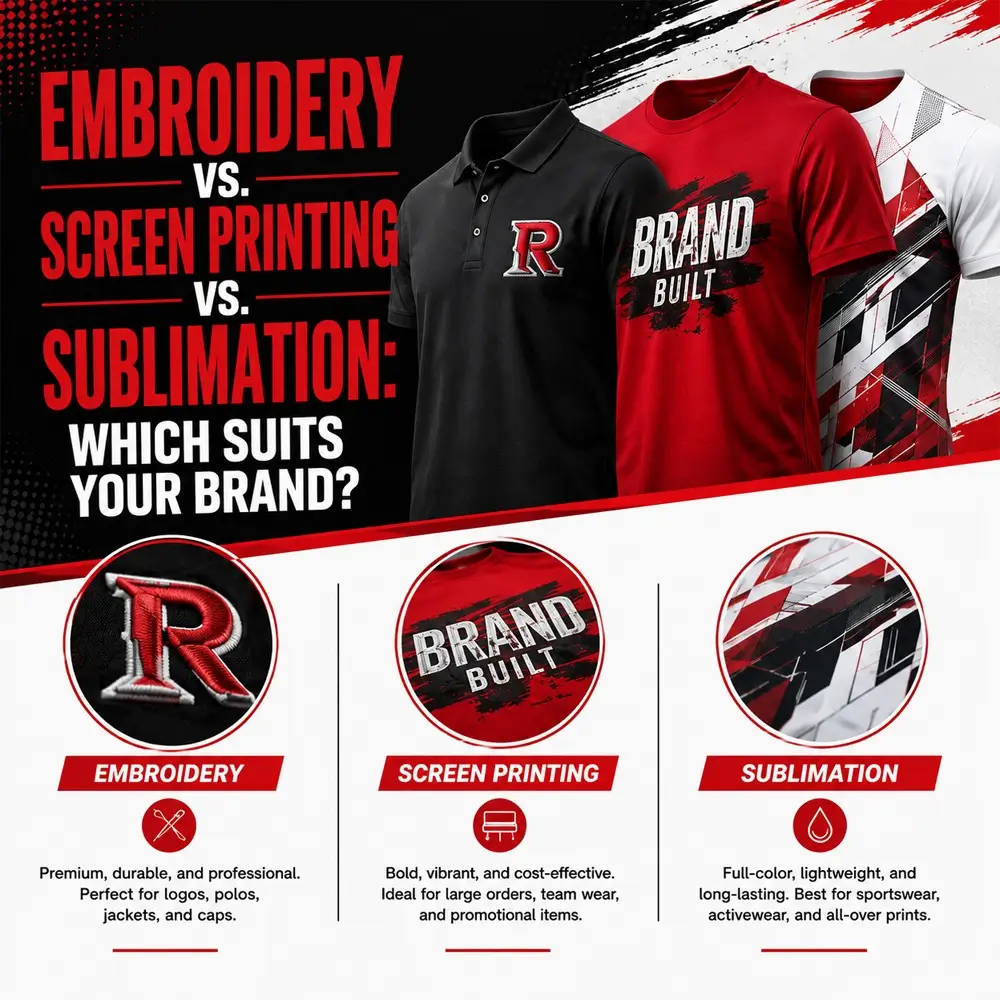
When I planned to start my own brand, I had the shirt and hat. But the hard part was how to put the logo on the product. Whether you are a retailer or a buyer, this step can create a huge difference for your inventory. The wrong method will end up leaving you with unsold inventory.
Embroidery vs. Screen Printing vs. Sublimation: Which Suits Your Brand? This is always a topic of debate for every startup and business. The answer depends on your fabric, budget, and volume of production. Let’s break it down simply so you can buy with confidence.
The Quick Answer: A High-Level Comparison
We are going to look at the three big players in custom decoration. Here is the short version.
Custom Apparel With the Right Decoration Method for Your Brand
Ready to start your next run of custom apparel? Check out our whole collection. We will help you pick the right decoration method for your specific needs and budget.
Browse Our CollectionMethod 1: Embroidery (The Heavyweight)
If you want your brand to look expensive, this is usually the way to go. Think of golf polos, work uniforms, and dad hats. Embroidery looks professional because it has texture and weight.
- Durability: Survives hundreds of washes. The thread is tough.
- Perceived Value: Feels premium. Adds a 3D texture that printing cannot match.
- No Fading: Unlike ink, thread holds its color for years.
- Detail Limits: Cannot stitch tiny text or complex gradients. Small letters bunch up.
- Cost: Usually more expensive per unit than printing.
- Feel: The back can feel scratchy without proper backing.
- Hats and beanies
- Polo shirts and button-downs
- Jackets, fleece-hoodies, and outerwear
- Left-chest logos
Method 2: Screen Printing (The Bulk Worker)
Screen printing is the standard for T-shirts. If you go to a concert and buy a band tee, it is likely screen printed. It uses a stencil and a squeegee to push ink onto the garment.
- Cost-Effective for Bulk: Setup takes time, but once started you can print hundreds fast. More you order, cheaper it gets.
- Vibrancy: Plastisol ink sits on top, making colors pop even on dark shirts.
- Soft Feel: Modern water-based inks feel like part of the shirt, not a plastic sticker.
- Setup Fees: You pay for each color. 5-color logo = 5 screens.
- Minimums: Some shops require a minimum of 12 or 24 pieces.
- Durability: Cheap screen printing will crack over time if washed incorrectly.
- Large orders of T-shirts
- Simple logos with 1–3 colors
- Gym bags and event giveaways
Method 3: Sublimation (The Color Bomb)
Sublimation is a science experiment. The printer turns solid ink into a gas (skipping the liquid phase) and forces that gas into the fabric. It only works on 100% polyester — like custom gym merchandise — or materials with a special polymer coating.
- Unlimited Colors: Print photographs, gradients, and detailed artwork at no extra cost.
- Zero Feel: The ink becomes part of the fabric — it will never crack or peel.
- All-Over Prints: The only way to print a design that covers the entire shirt edge to edge.
- Fabric Limitation: Only works on white or light-colored polyester. Cannot sublimate on black cotton.
- White Ghosting: If the fabric folds during pressing, the crease stays white.
- Heat Sensitivity: High heat can cause dye migration over a long period.
- Custom leggings and athletic wear
- Polyester sports jerseys
- Mugs and mousepads (hard goods)
- All-over print shirts
Head-to-Head: The Deciding Factors
To pick the winner, you need to look at your specific situation. Let’s compare based on what buyers usually worry about most.
1. Fabric Type
This is the first filter.
2. Design Complexity
3. The “Hand Feel”
4. Cost Per Unit
Summary Comparison Table
| Factor | Embroidery | Screen Printing | Sublimation |
|---|---|---|---|
| Fabric | Cotton, outerwear | Cotton, blends | Polyester only |
| Color Range | Limited (thread colors) | Up to ~8 colors | Unlimited |
| Best Detail | Low (no tiny text) | Medium | Very high (photo-quality) |
| Hand Feel | Heavy, textured (3D) | Flat or soft | Zero — embedded |
| Best Volume | Small runs | Large bulk orders | Any quantity |
| Durability | Very high | Medium (depends on ink) | Very high (can’t peel) |
| Cost Efficiency | Higher per unit | Drops sharply at volume | Flat rate per color |
How to Choose for Your Brand?
Still stuck? Here is a simple decision tree.
A Note on Blends
What if your shirt is a 50/50 cotton/polyester blend?
Quality Red Flags to Watch For
When you are buying from a supplier, you need to ask the right questions to ensure you don’t get a bad product.
FortStitch: Experienced Partner for End-to-End Solutions
FortStitch is not an ordinary supplier that only handles stitching. We are a strategic partner who provides end-to-end solutions. From sourcing fabric to cutting, sewing, customization, and shipping — we handle and manage every step throughout the process. You don’t need to worry about different tasks and quality.
With our in-house production, we have control over every step. We can maintain consistent quality in every order. We offer the best rates and flexible terms, with the best solutions for startups and brands. Let us handle the complex production process so you can focus on growing your brand.
From Raw Fabric to Final Decoration — We Handle It All
Partner with FortStitch for a seamless, end-to-end manufacturing experience. From raw fabric to final decoration, we handle it all under one roof. Contact us to start with a free quote.
Browse Our CollectionConclusion
Choosing between Embroidery, Screen Printing, and Sublimation doesn’t have to be stressful. It comes down to what you are making.
Pick Embroidery for texture and durability. Pick Screen Printing for bulk cotton tees. Pick Sublimation for endless color on polyester.
If you are still unsure, the team at Fort Stitch can help you look at your artwork and fabric to suggest the best method. We want your brand to look its best — because your success is our success.
FAQs
Q1. Is embroidery more expensive than screen printing?
Generally, yes. Embroidery involves thread and complex machine setup. However, for very small orders, screen printing setup fees can make it more expensive per piece than embroidery.
Q2. Can I use sublimation on cotton shirts?
No. Sublimation requires polyester or a polymer-coated surface. On cotton, the gas has nothing to bond to, and the design will wash out almost immediately.
Q3. Does screen printing crack?
Cheap plastisol ink can crack over time if washed in hot water or stretched too hard. High-quality screen printing that is properly cured should last for years without cracking.
Q4. Which method lasts the longest?
Embroidery usually lasts the longest because thread is extremely durable. Sublimation also lasts a long time on polyester because it cannot crack or peel.
Q5. Can I embroider a very small design?
No. Text smaller than about 1/4 inch tall will become illegible with thread. You would need to use screen printing or sublimation for tiny, detailed text.