
FortStitch

Sublimation Sportswear Manufacturing Guide From Design To Finished Good

The Complete sublimation sportswear manufacturing guide

How do you feel when you put on your team jersey? The boost in your confidence is not only from the training, but it comes when your gear is as sharp as you. But finding a sportswear or a sportswear supplier who understands this is not so easy. Cracked logos, faded numbers, and peeling names are common problems.

But in the present world, sublimation printing has changed the game. Personalized jerseys with colorful designs attached forever through a precise process. This sublimation sportswear manufacturing guide is all about the behind-the-scenes story. You will see the entire journey and get the insights about how your sportswear walks through from design idea to the finished uniform.

Sublimation Sportswear Manufacturing Guide: Complete Breakdown

Now let’s understand the complete cycle, starting from what is sublimation to printing a whole uniform. Understanding this science helps you make smarter choices down the road.

What is Sublimation Printing?

Let us break it down in the simplest way possible. Often, when you print a design on a T-shirt, it sits on top of the fabric like a sticker. Over time, that sticker cracks, fades, or peels off completely.

Sublimation does the opposite. Instead of sitting on top, the ink turns into a gas under high heat and bonds with the fabric fibers. Think of it like dyeing your hair — the color becomes part of the hair, not something painted on the outside. That is why sublimation printing creates colorful designs that attach to the garment forever.

The Full Manufacturing Process: Step-by-Step

Now we are going to start an entire journey. How do we complete your sublimation order for gym wear apparel or custom active wear apparel? The following step-by-step process will help you avoid costly mistakes. Each stage is important and can affect the quality of your end product.

Step 1
Design and Tech Pack Creation
Every assignment starts with a design. Design software like Adobe Illustrator or CorelDRAW creates the artwork — a combination of colors, logos, and player details. But design alone is not enough. You also need a tech pack, which is a document that tells the manufacturer exactly what you want: fabric type, collar style, logo placement, and stitch colors. Think of the tech pack as a recipe card. Good file creation at this stage means saving your artwork. This is the foundation of your precise process, so take your time here.
Step 2
Fabric Selection and Sourcing
Now you choose the fabric that will carry your colorful designs. For sublimation printing, you need polyester — because only polyester fibers can bond with the ink gas. Most performance clothes and training clothing use 100% polyester or a blend with at least 90% polyester. The weight of the fabric matters too. Lightweight fabrics around 140 GSM work well for hot-weather sports. Heavier 200 GSM fabrics feel more premium and durable. This step also affects comfort. Moisture-wicking and anti-bacterial finishes can improve performance.
Step 3
Printing the Design onto Transfer Paper
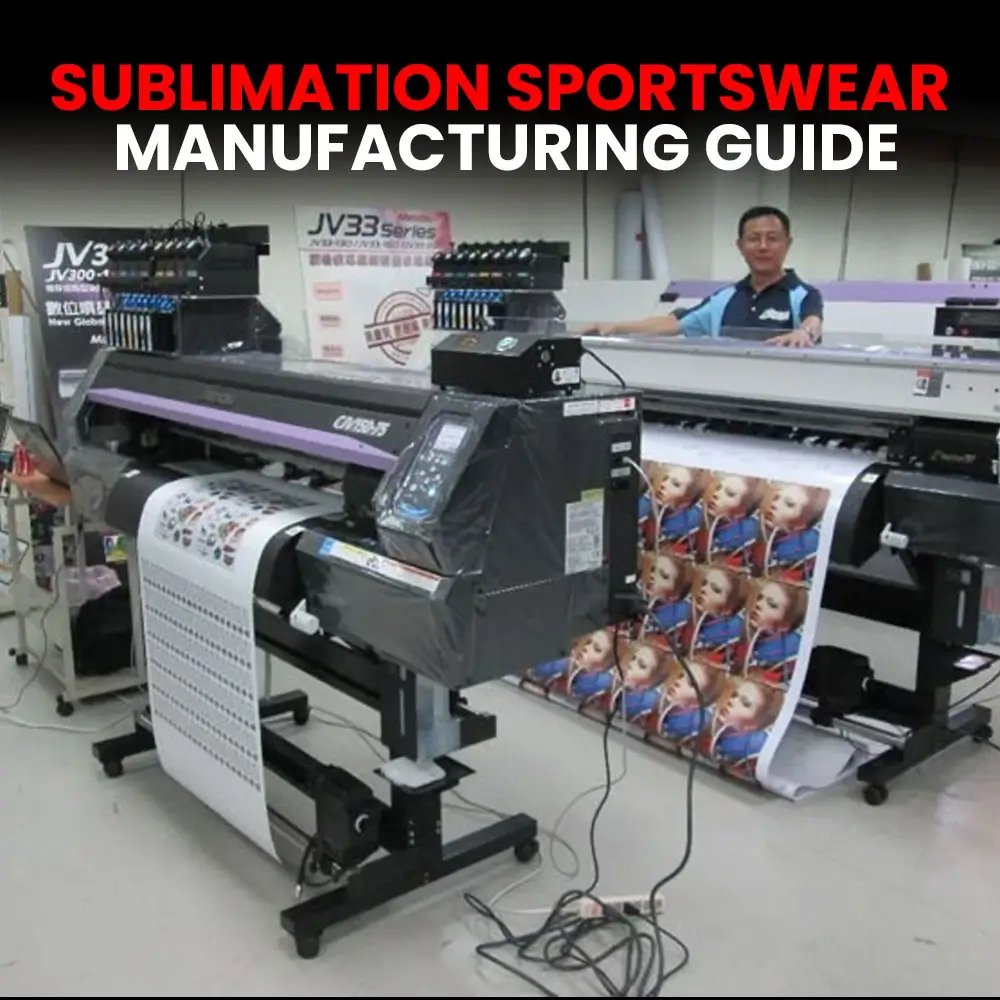
Once we choose the fabric and approve the design, the factory prints your artwork onto special transfer paper. This is not ordinary paper — it has a coating that holds the sublimation ink until heat releases it. Large-format printers lay down the design in a mirror image, meaning everything appears backwards. This is intentional. When we flip the paper onto the fabric, the design transfers in the correct direction. The colors on the paper may look dull at this stage, but they will burst into life once we apply the heat. This is part of why sublimation designs need a skilled operator who understands color profiles and ink limits.
Step 4
Heat Press Transfer
Here comes the magic moment. We place the printed transfer paper face down onto the white polyester fabric and place both under a heat press. Under high heat — usually around 200 degrees Celsius — and strong pressure, the solid ink turns into a gas. This gas penetrates the open pores of the polyester fibers and dyes them from the inside. When the fabric cools, the pores close and trap the color forever. This is why sublimation designs attach forever to the garment. The paper peels away, leaving the design behind with zero texture and zero chance of peeling. For personalized cotton sports t-shirts or jerseys, this means names and numbers are part of the shirt, not stuck on top.
Step 5
Cutting the Fabric Panels
After printing the fabric, it is time to cut out each piece of the jersey. This is not done with scissors by hand. Factories use automated cutting machines or laser cutters that follow digital patterns. These machines can cut through layers at once, saving time and keeping every piece identical. The cutting stage must be accurate — because even a few millimeters of error can make a sleeve fit odd or a collar sit crooked. Your manufacturer should use markers and digital layouts that arrange pattern pieces to waste as little fabric as possible. Good cutting is a sign of a factory that respects your budget and your deadline.
Step 6
Sewing and Assembly
Now skilled workers sew the cut panels together into a finished sportswear jersey. This is where details like flatlock stitching, reinforced seams, and hem quality come into play. Flatlock stitching is popular in training clothing — it sits flat against the skin and reduces chafing during movement. Collars, cuffs, and zippers are added at this stage too. A good manufacturer will have quality checks during assembly, making sure each stitch line is straight and strong. If your design includes panels of different colors, the sewer must align them so the pattern flows without interruption. This stage turns flat printed fabric into a three-dimensional garment ready for action.
Step 7
Quality Control and Inspection
Before packing your personalized jerseys, they must pass a quality control check. Inspectors look for common problems such as misaligned prints, loose threads, color differences, and sizing errors. They may also perform tests like checking seam strength, measuring wash fastness, and verifying that the design does not fade under friction. Some factories follow international standards like AQL (Acceptable Quality Level), checking a certain number of pieces from each batch. If too many fail, they may need to rework the entire order. This precise process protects you from receiving damaged or incorrect products.
Step 8
Finishing, Packaging, and Logistics
The final step prepares your order for delivery. Each garment is folded and placed into a bag to keep it clean during shipping. If you requested custom packaging — such as branded hang tags or logo-printed bags — we provide them on demand. Jerseys are then packed into sturdy cartons with packing lists attached. Your manufacturer will help you choose between logistic options: air freight (faster but more expensive) or sea freight (slower but cost-saving). Once the boxes arrive, you open them to find performance clothes ready to wear, built exactly to your step-by-step process specifications.
Built to Perform. Made to Last.

Partner with a Factory That Gets Every Step Right

Partner with a factory that follows a proven step-by-step process, values your file creation efforts, and delivers performance clothes that last. Check our collection today to see how experts craft high-performance gear.

Check Our Collection

Cost Breakdown: What Affects Sublimation Price Per Piece

Let us talk money. Understanding what drives the cost of your sublimation printing order puts you in control during negotiations with any manufacturer. No two orders will have the same price, and small choices can make a big difference to your final bill. Here are the key factors that affect your price per piece.

Factor 01
Order Quantity
Larger orders spread setup costs across more pieces, so your price per garment drops. Ordering 50 pieces will cost more per piece than ordering 500 pieces.
Factor 02
Fabric Type and Weight
Premium polyester blends or heavier GSM fabrics cost more than basic lightweight options. Moisture-wicking or anti-bacterial finishes also add to the material price.
Factor 03
Design Complexity
A design with many colors, gradients, or intricate patterns requires more ink and longer printing time. Simple sublimation designs with fewer elements are faster and cheaper to produce.
Factor 04
Number of Print Panels
If your sportswear jersey has different designs on the front, back, sleeves, and collar, each panel adds printing and alignment work. More panels mean more labor and a higher cost.
Factor 05
Customization Volume
Adding individual names and numbers to personalized jerseys takes extra time per piece. The more customized each garment is, the higher the labor cost climbs.

Sublimation vs. Other Methods: When to Choose What

Not every printing method suits every project. Use this decision framework to find the best fit for your order before committing to a manufacturer.

Method Pros Cons When to Choose
Sublimation Printing Permanently attached, no peel or crack, zero texture, unlimited colors, full all-over prints, lightweight Only polyester, needs a light base, no metallics, color shift possible, setup cost for file creation All-over sportswear jerseys, personalized jerseys, training clothing, complex sublimation designs
Screen Printing Works on cotton, bold opaque colors, cheap on bulk, metallic inks possible Per-color screen fee, can crack or fade, no all-over prints, feels heavy on thin garments Simple logos on cotton tees, large bulk orders, bold solid prints
Embroidery Premium look, extremely durable, works on any fabric, accurate thread colors Expensive for large designs, adds weight, no gradients, small text blurs Polo shirts, caps, jackets, left-chest logos, high-end performance clothes
Heat Transfer Vinyl Fast personalized jerseys, works on many fabrics, metallic and glitter effects, no minimum order Can peel or crack, texture sits on garment, low durability, not for complex designs Small-batch names and numbers, event merch, urgent training clothing orders
Direct-to-Garment (DTG) Photo-quality prints, no setup, good on cotton, soft feel Slow, less vibrant on polyester, lower durability than sublimation, cost stays high Small cotton batches, detailed photos, and sample garment testing

Common Defects & How to Avoid Them

Even with a good manufacturer, things can sometimes go wrong during sublimation printing. Knowing the most common defects ahead of time helps you catch problems early. Here is what to watch for and how to keep your sportswear jerseys flawless.

Common Defects

Ghosting or Shadow Effect
A faint double image appears next to your design, making it look blurry. This happens when the transfer paper shifts during the heat press stage.
Color Mismatch
The colorful designs on your finished garment look different from what you saw on screen. This occurs when color profiles are not matched between the design software and the printer.
White Crease Marks
Thin white lines or fold marks run across the printed fabric. These appear when the transfer paper has wrinkles or the fabric was not laid flat before pressing.
Uneven or Faded Patches
Some areas of the print look lighter or washed out. This defect is due to uneven heat or pressure distribution during the precise process of sublimation.

How to Avoid Them

✓ Secure the Transfer Paper
Ask your manufacturer to use heat-resistant tape to hold the paper in place. This stops any movement and prevents ghosting or shadow effects.
✓ Request a Pre-Production Sample
Always approve a physical sample before bulk production begins. This lets you check the exact colors, fabric feel, and quality of your sublimation designs.
✓ Check Paper and Fabric Handling
Make sure the factory inspects transfer paper for wrinkles and smooths the fabric before pressing. A clean, flat surface makes all the difference.
✓ Test Heat Press Calibration
Confirm that your manufacturer tests heat press machines for even temperature and pressure. Calibrated equipment delivers consistent results on every sportswear jersey.

How to Choose a Sublimation Manufacturer?

Choosing a partner for sublimation printing can be very hard. There are so many factories that claim they are the best. But not all manufacturers are the same. Choosing the wrong partner will not only waste money — it will also destroy your brand’s reputation. There are a lot of factors you need to consider. But this does not apply to everyone.

Brands like Fort Stitch are manufacturers that have built their reputation on trust. With deep expertise in sublimation printing and quality production, they know how to create colorful designs that are permanent and reliable. With a transparent pricing system and flexible terms for startups, they give fair attention to the order of every scale.

From First Sketch to Final Stitch

Bring Your Designs to Life With a Partner You Can Count On

Ready to bring your designs to life with a partner you can count on? Reach out to FortStitch today and let their team guide you through every stage of the sublimation printing journey, from your first sketch to the final stitch.

Contact Us for a Free Quote

Conclusion

Here we are — we have the complete roadmap of sublimation printing for sportswear. From understanding the system and science to mastering the process, you know what it takes to create standout sportswear jerseys. From personalized jerseys to durable training clothing, the right manufacturer is the key. Keep your file creation and sublimation designs sharp, and quality standards high. High-performance clothes start with smart choices and a trusted partner.


FAQs

Q1. What sublimation items sell best?

Personalized jerseys, team uniforms, training clothing, and leggings sell best. Also popular are hoodies, jackets, shorts, and accessories like headbands. Performance sportswear with full all-over prints remains the top seller.

Q2. How are fully sublimated jerseys made?

Designs are printed on transfer paper, then heat-pressed onto polyester fabric. Ink becomes gas and bonds into fibers, making designs permanently attached. Cut panels are sewn together into finished sportswear jerseys.

Q3. What lasts longer, sublimation or DTF?

Sublimation lasts longer because the design becomes part of the garment fibers. DTF transfers sit on the fabric surface and may crack or peel over time. Sublimation is more durable for performance clothes.

Q4. What are common sublimation mistakes?

Ghosting from paper shifting, color mismatch from poor file creation, white crease marks from wrinkled paper, and uneven prints from faulty heat press calibration. A precise process avoids these errors.

Q5. What are the disadvantages of sublimation?

Sublimation only works on polyester fabrics, needs light base colors, cannot produce metallic prints, may have color shift, and has setup costs for small orders. Sublimation printing is limited to polyester-rich garments.

Leave a Reply

Your email address will not be published. Required fields are marked *