
4 Common Manufacturing Mistakes in Boxing Gear (And How We Avoid Them)

You have a pair of boxing gloves to train and rip after a few weeks. Or you have felt a hard lump in the padding where your knuckles land. It isn’t very pleasant. Because you have invested your money in gear you think can protect you. That failure in your gear will put your training and safety at risk.
If you think it’s an accident, you are mistaken. This all has happened due to manufacturing shortcuts. Using low-quality foam, weak stitching, and skipping crucial quality checks. At Fort Stitch, quality is not what we check at the end. It’s a process you follow in every step, not an inspection.
In this article, we will cover the critical failure points that lead to broken gear. Not only this, but we will also tell you how we avoid these mistakes. Let’s get started.
Common Manufacturing Mistakes in Boxing Gear
It is important to know how the boxing gloves are made. The following are the most common manufacturing mistakes that occur in boxing gear that result in wear and tear or even injury sometimes.
Mistake 1: The Compromise on Padding & Protection
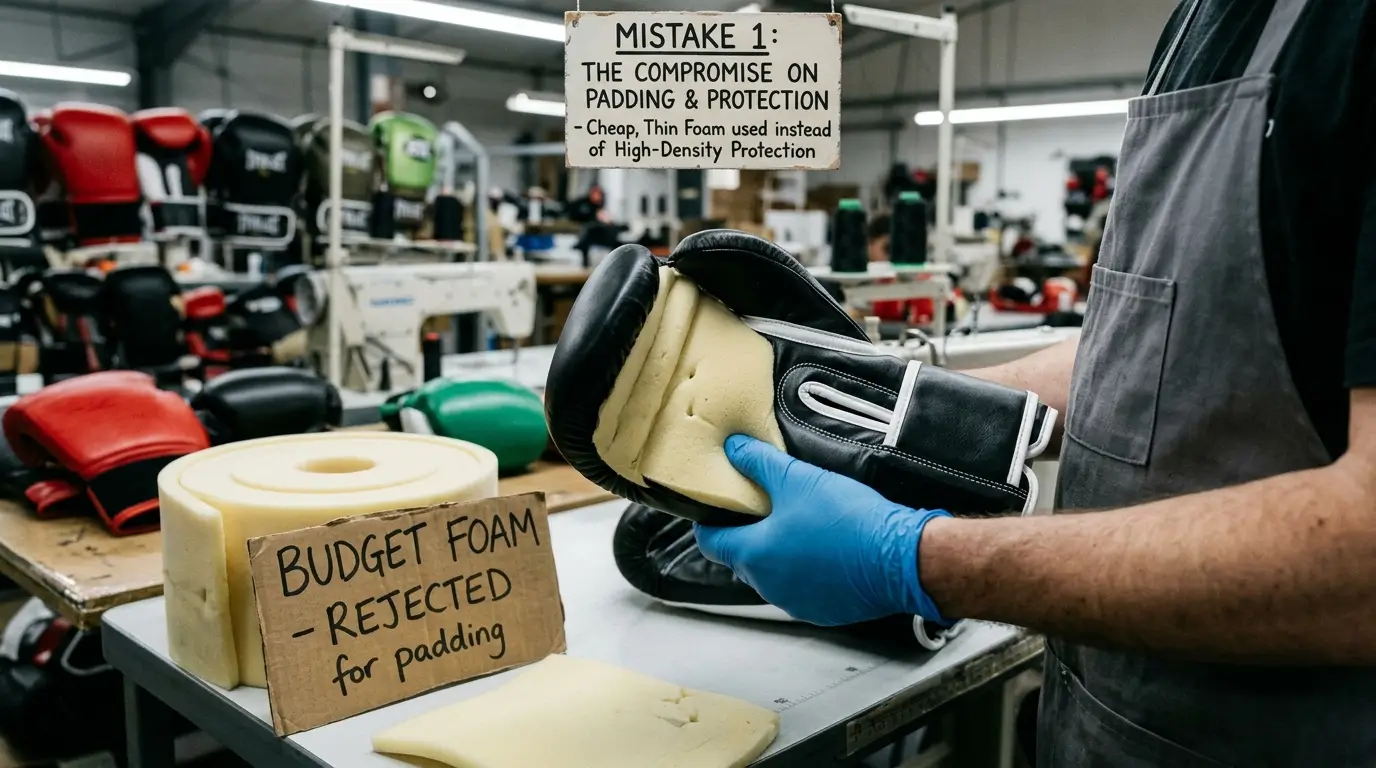
When you punch, it’s your gloves that protect your hands. But not when the padding is low-quality. Many manufacturers save their budget by using cheap foam. They also use lumpy fillers that pack down over time. It’s like a mattress that becomes uncomfortable fast. This flaw means your glove has uneven protection. No idea when a punch can land on a hard spot or with a gap, no cushion at all.
This is not only for comfort but also a major safety risk. This gap increases the risk of injury even from simple aches and bruises. When left with a gear that wears out fast, your hand and progress are at risk.
How Fort Stitch Built True Protection?
When manufacturing customized boxing gloves, we never put safety at risk. We always use pre-molded multi-density foam modules. Each module is molded according to the exact shape. So, they fit the hand’s knuckles and joints. This creates a uniform shield of protection that remains in position. We test every foam formulation to ensure it meets high standards. This results in a padding you can rely on punch after punch.
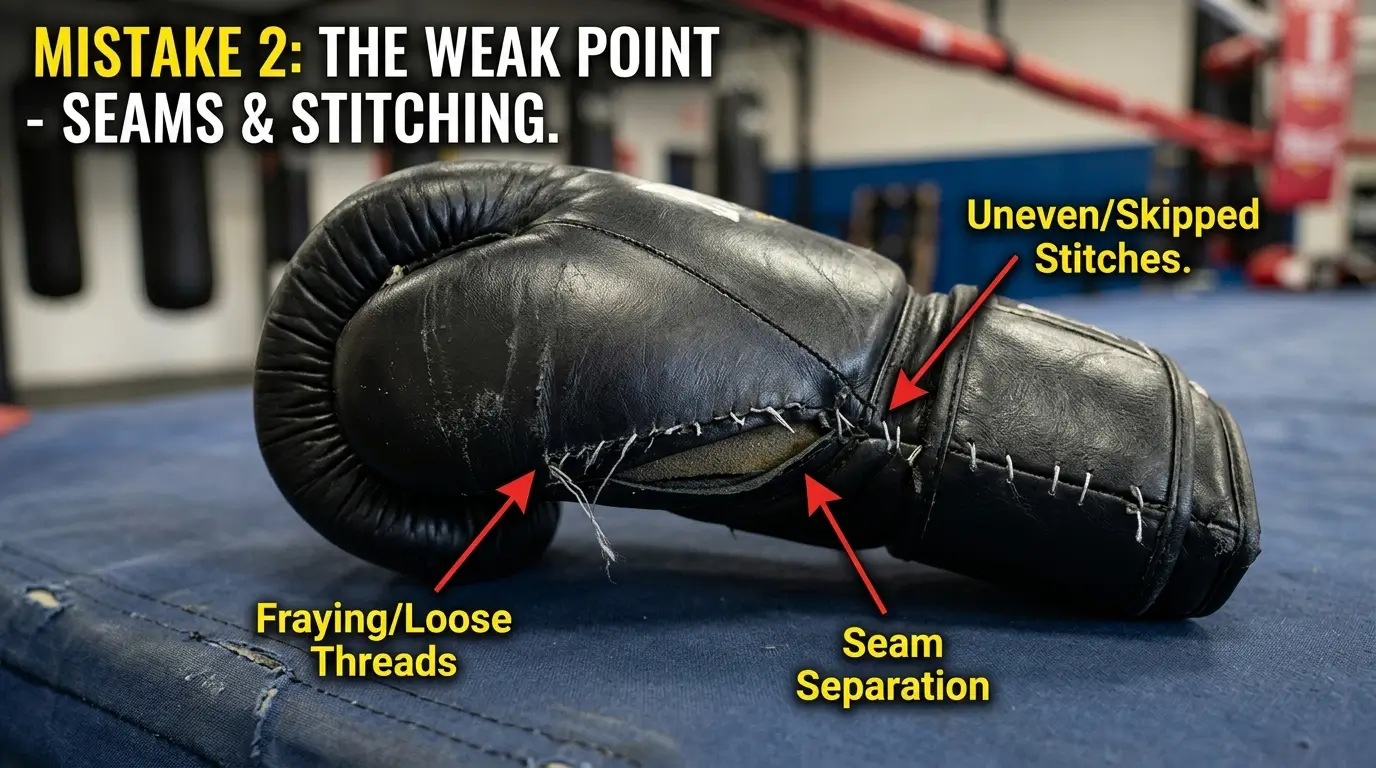
Mistake 2: The Weak Point: Seams & Stitching
The seams of a boxing glove are the same as the stitches holding a football together. If they are weak, the ball falls apart on the very first kick. This is a huge gap and shortcut in the glove manufacturing process.
Using single-row stitching with cheap and low-grade thread while ignoring critical spots. Like where your thumb meets the palm or the cuff wraps your wrist. This is where the most stress comes when you punch every time.
The risk is straightforward seam blowouts. One day you train, and the next day the gap appears wider. This is not a cosmetic issue, but a clear manufacturing negligence. Due to this, the whole glove can lose its shape and risk your protection. This fails your equipment when needed the most.
How Fort Stitch Creates Unbreakable Bonds?
Fort Stitch builds strength from the start. We never rely only on hope it will hold. No single-stitch shortcuts. We use triple-stitching with high tensile bonded with nylon thread. This is much stronger than standard polyester.
At tthe humb crotch and cuff, which is a high-stress spot. We add an extra layer of defense,e reinforcing backing panels. Made with high-rigidity materials like Texon, creating a shock-absorbing barrier. Also using twist strap attachments for key anchor points, which divide the force over a wider area. All equipment at Fort Stitch is made with the same quality, including standing punching bags and champion belts.
Mistake 3: The Illusion of Wrist Support
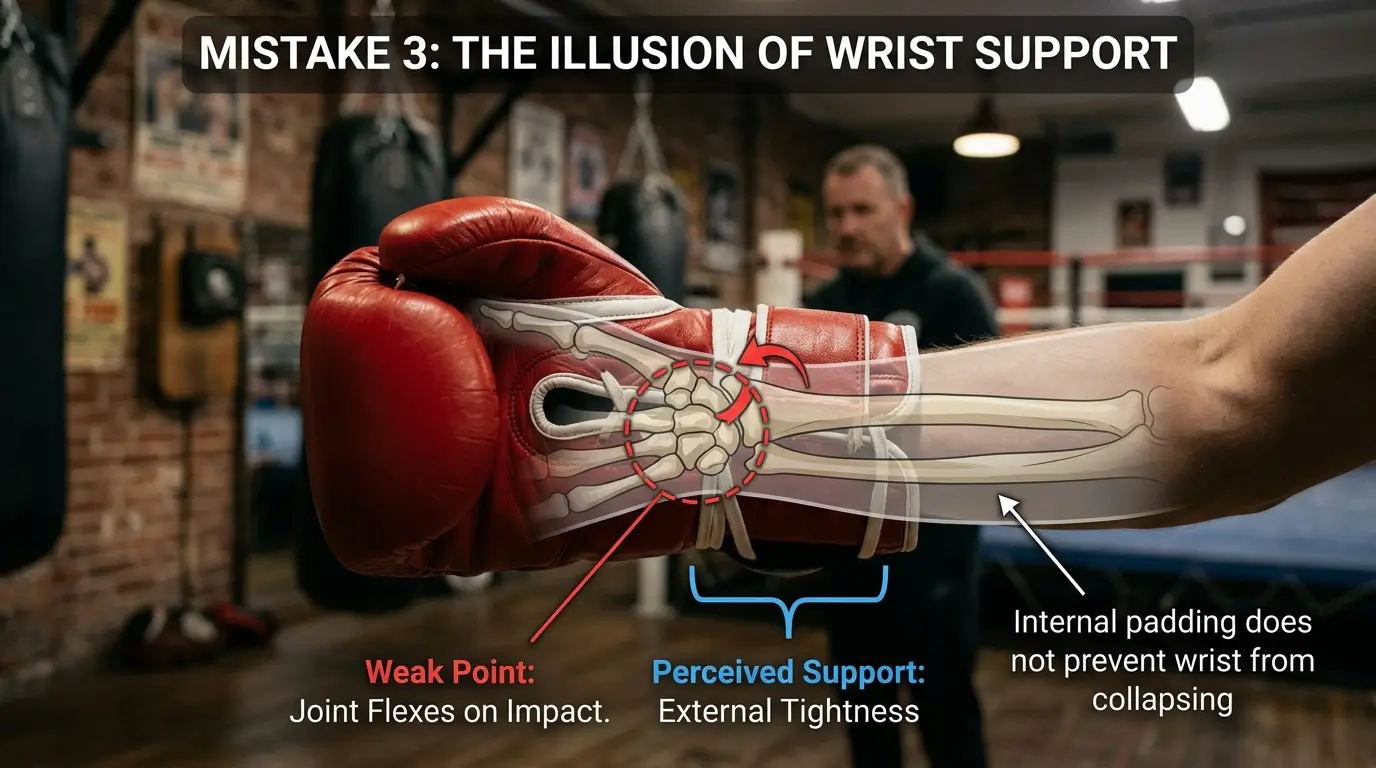
If you want your punch to land safely, your wrist is the foundation. If your wrist bends on impact, it will destroy your joint. Manufacturers use flimsy straps to create an illusion of support. These low-quality straps lose their grip after a few weeks. You may need to retighten them again and again. This breaks your focus and workout flow.
If this is the case with you,u your wrist is at serious risk of injury. This is one of the most common injuries in boxing. This happens due to poor gear quality. When your wrist is not in the right place, it can flex backward and also leads to poor punch transfer. Result: weaker punches and a wrist begging for a break.
How Fort Stitch Creates Wrist Stability?
Fort Stitch builds a support system, as a strip of Velcro is not enough. With an integrated molded wrist spine that sits against the bottom of your forearm. It prevents your wrist from bending into a weak position.
Also secured with a wide wrap-around strap system. This creates a uniform and stable channel for your hand and wrist. In the last, industrial-grade hook and loop that never wears out, even after thousands of closures. Get the same quality for custom MMA gear and body protectors. Ask us for a free quote.
Mistake 4: Material Misrepresentation
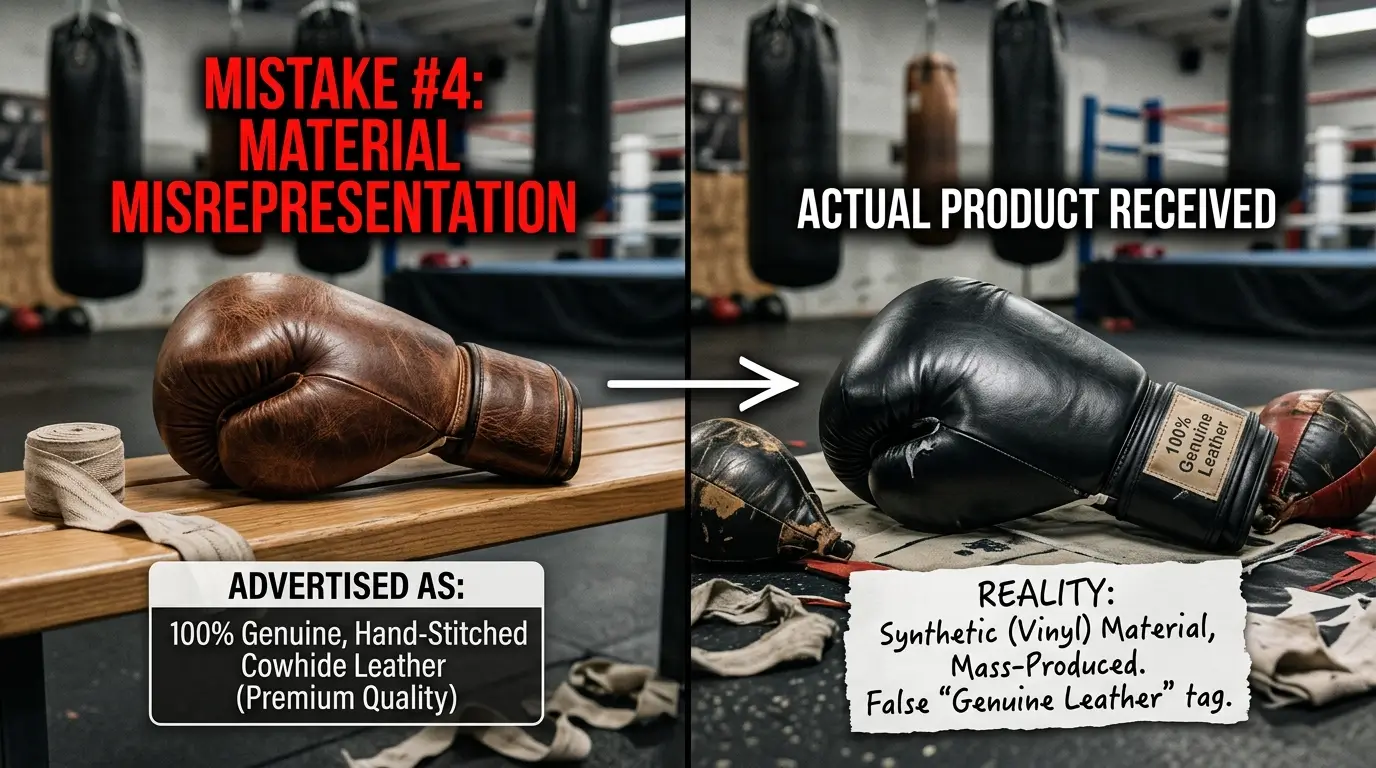
What matters in your boxing gear is inside. May it look tough from out butis t built to last? A common shortcut in boxing gear is material misrepresentation. You must understand this before buying boxing gear in bulk. This can be in various forms. Like using low-quality leather like the sanded down or synthetics that don’t breathe. They also don’t fight moisture or odor.
The high-risk zones are your hands and nose. Also, inferior leather cracks and peels with time. Poor synthetics become sticky and tear soon. Also, they trap moisture and odor, which leads them to become uncomfortable.
How Fort Stitch Guarantees High-Performance Materials?
FortStitch’s mission is to create radical transparency. No misleading terms like “genuine leather”. We not only promise but deliver high-quality material. We use full-grain bovine leather that is the strongest and gets better over time. Not only in boxing gloves but in laced-up gloves and custom punching bags also.
For advanced synthetic options, we have engineered HydraFlex, tested for strength. Also treated with an antimicrobial coating to resist odor. Every material undergoes advanced tanning treatments to ensure hygiene and longevity.
How Does Fort Stitch Gear Transform Your Performance?
Fort Stitch brings you quality by rejecting common shortcuts, not by accident. We use high-class foam, reinforced stitching, and an advanced support system in every aspect. We ensure you transparency and a strong commitment to the same process.
You can choose any gear: synthetic leather gloves or speed balls. We promise the same quality in every gear. Be confident while investing and performing.
Conclusion
In the end, investing in gear is an investment in your potential. You can train harder, push your limits, and perform with confidence. This is what Fort Stitch aims to do: turn the fear of gear failure into power.
Ready to experience the difference? Explore our entire boxing gear collection, where every piece of gear has the same quality standard.
FAQs
Q1. What are some common boxing mistakes?
Dropping the lead hand, leaving the chin up, squaring up too much, neglecting footwork, telegraphing punches, and holding the breath. These errors reduce defense, power, and endurance, leaving boxers vulnerable to counters.
Q2. What boxer has a 100% KO ratio?
Edwin Valero (27–0, 27 KOs) and current light-heavyweight champion Artur Beterbiev (20–0, 20 KOs) are notable boxers with a perfect 100% knockout ratio. Valero’s career ended tragically; Beterbiev remains active.
Q3. What do 1, 2, 3, 4, 5, 6 mean in boxing?
It’s the basic punch numbering system: 1 – Jab, 2 – Cross, 3 – Lead Hook, 4 – Rear Hook, 5 – Lead Uppercut, 6 – Rear Uppercut. Trainers call these numbers for quick combination drills
Q4. Why do people use 16 oz boxing gloves instead of 14 oz?
16 oz gloves provide more padding, making them the standard for sparring to protect partners and reduce injury risk. The extra weight also builds shoulder endurance and conditions fighters for fight-speed with lighter gloves.
Q5. How heavy were Mike Tyson’s gloves?
In professional heavyweight bouts, Mike Tyson wore 10 oz gloves, as mandated. For sparring and training, he frequently used heavier 16–18 oz gloves to develop punishing speed and power with lighter fight gloves.